
Which types of printing should you choose?
New post
26 July 2024
Hi! It’s Marion, I’m a graphic designer and YES I use CANVA, I’m going to give you a few tips to create your print file!
Which types of printing should you choose?
Don’t panic — the whole DTP team is here to advise you on the printing technique best suited to your project.
The choice of printing type depends on several factors, in particular the type of project, the budget, the desired quality and the material you are printing on. Here is an overview of the main types of printing available and their common uses:
1. Digital printing
Advantages: Fast, economical for small print runs, allows personalised printing.
Uses: Flyers, brochures, business cards, posters in small quantities, marketing documents.
2. Offset printing
Advantages: High print quality, economical for large print runs, wide choice of materials.
Uses: Magazines, books, large quantities of brochures, catalogues.
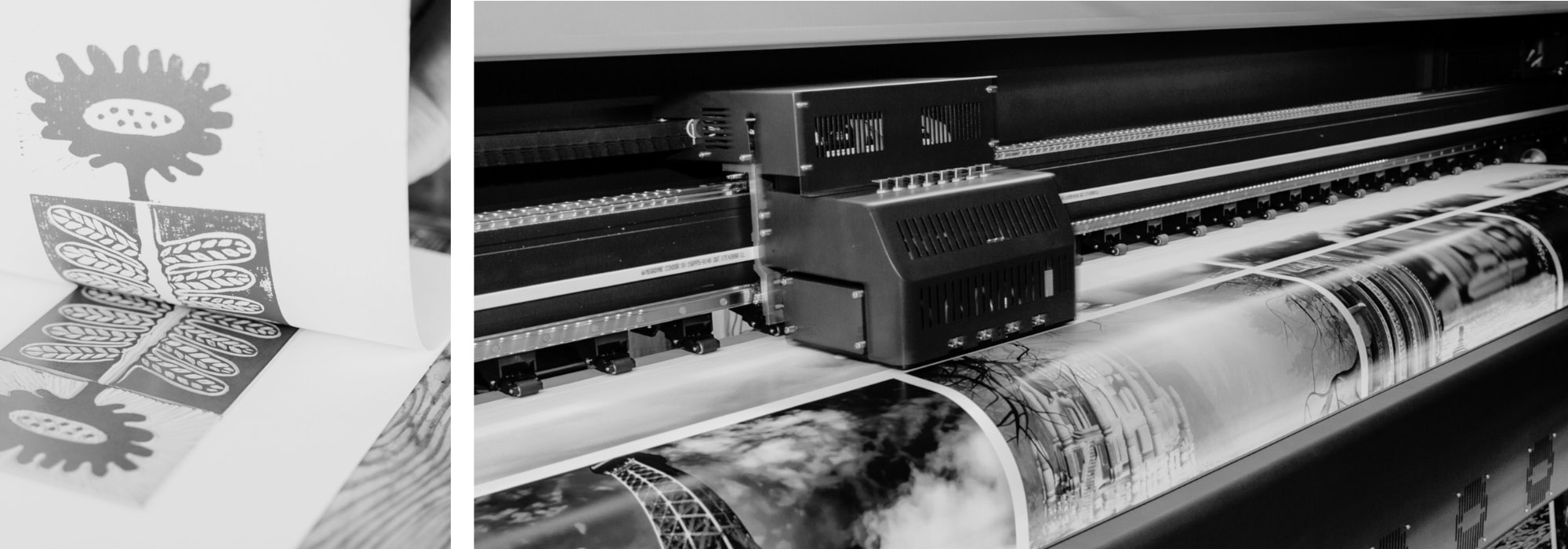
3. Inkjet printing
Advantages: Able to print on a variety of materials (paper, fabric, etc.), good for print-on-demand and large formats.
Uses: Posters, banners, art printing, documents requiring high colour fidelity.
4. Laser printing
Advantages: Fast, effective for text and simple graphics, good for high-volume printing.
Uses: Office documents, reports, manuals, labels.
5. Screen printing
Advantages: Ideal for printing on unconventional materials, durable and hard-wearing.
Uses: Clothing, posters, signage, promotional items.
6. Laser engraving and cutting
Advantages: High precision, the ability to create complex designs.
Uses: Metal, wood and plastic objects, artistic and industrial projects.
7. 3D printing
Advantages: Enables the creation of three-dimensional objects, ideal for prototypes and custom items.
Uses: Rapid prototyping, spare parts, decorative objects, architectural models.
8. Flexography
Advantages: Good for printing on flexible, non-porous packaging, fast and economical for large print runs.
Uses: Packaging, labels, plastic bags.
9. Lithography
Advantages: Excellent image quality, used mainly for art prints.
Uses: Artworks, high-quality art prints.